CrowdStrike 2026 Global Threat Report: what business leaders should know

CrowdStrike just released their 2026 Global Threat Report, and the subtitle says it all: Year of the Evasive Adversary. The report is dense (50+ pages of threat intelligence), so here’s a breakdown of what matters most if you’re running a business and want to stay informed without wading through the entire thing.
The big picture
Attackers are getting faster, quieter, and more creative. That’s the consistent theme across this year’s report. Rather than relying on traditional malware, adversaries are increasingly using stolen credentials, legitimate tools, and social engineering to blend in with normal activity. The goal isn’t just to get in – it’s to look like they belong there.
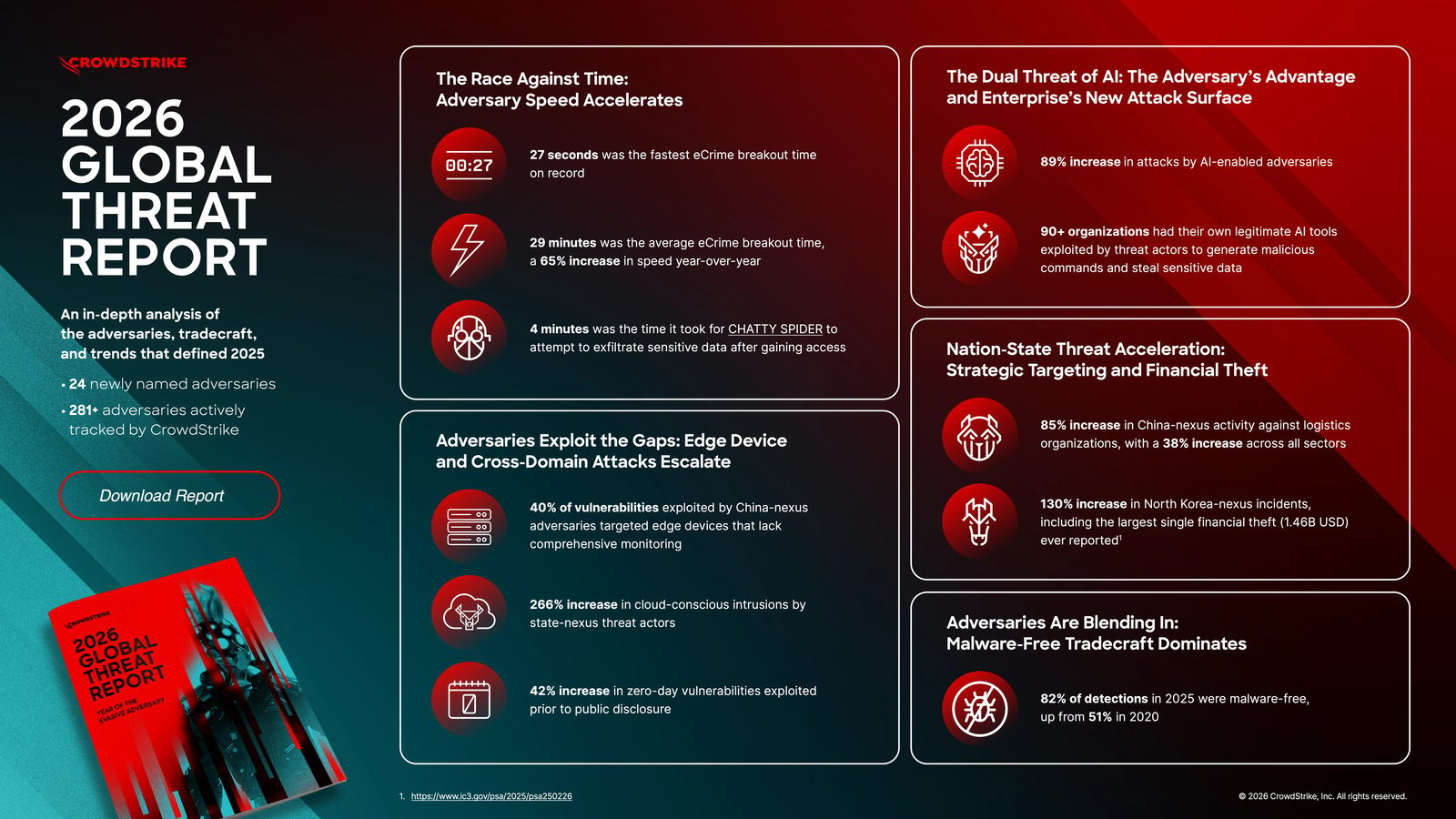
CrowdStrike tracked 281+ adversaries in 2025, with 24 newly named threat groups added to the list. The sheer volume of activity is growing, but the way attacks happen is what’s really changing.
Speed is the story
The numbers around breakout time – how fast an attacker moves laterally after gaining initial access – are striking:
- 29 minutes: the average eCrime breakout time, 65% faster than the prior year
- 27 seconds: the fastest breakout time recorded
- 4 minutes: the time it took one threat actor to begin exfiltrating data after gaining access
The window between “something happened” and “it’s too late” keeps shrinking. This is why automated detection and response matters more than ever – manual review alone can’t keep up.
Malware is no longer the main event
82% of detections in 2025 were malware-free, up from 51% in 2020. That’s a significant shift. Instead of dropping malicious files that antivirus tools can catch, attackers are using:
- Stolen credentials to log in as legitimate users
- Living-off-the-land techniques using tools already installed on the system (PowerShell, remote management utilities, etc.)
- Social engineering and vishing (voice phishing) to trick employees into granting access
This means traditional antivirus alone isn’t enough. If an attacker logs in with valid credentials, there’s no malware to detect – they just look like another employee.
AI is changing the game on both sides
CrowdStrike reported an 89% increase in attacks by AI-enabled adversaries year-over-year. Attackers are using AI to:
- Generate more convincing phishing emails at scale
- Automate reconnaissance and vulnerability scanning
- Create deepfake content for social engineering
But there’s also a newer dimension: adversaries targeting AI systems themselves. Over 90 organizations had their own legitimate AI tools exploited by threat actors to generate unauthorized commands and steal sensitive data. As businesses adopt more AI-powered tools, those tools become part of the attack surface.
Cloud and identity attacks are surging
Cloud environments saw a 266% increase in intrusions by state-sponsored actors. Attackers are moving across domains – from on-premises systems to cloud platforms to SaaS applications – in a single intrusion, making it harder to detect when visibility is siloed.
The report highlights cross-domain attacks as a growing concern. An attacker might compromise an endpoint, use those credentials to access cloud email, then pivot to a connected SaaS application. Each step looks legitimate in isolation.
Nation-state activity at a glance
Without getting too deep into geopolitics, a few data points stand out:
- China-nexus activity increased 85% against logistics organizations and 38% across all sectors, with 40% of exploited vulnerabilities targeting edge devices (firewalls, VPN appliances, routers)
- North Korea-nexus incidents rose 130%, including the largest single financial theft ever reported at $1.46 billion
- State-sponsored groups are weaponizing publicly disclosed vulnerabilities within days of release – in one case, just 2 days
What this means for your business
The report is long, but the practical takeaways haven’t changed dramatically. They’ve just become more urgent:
- Identity protection is critical. Phishing-resistant MFA, strong password policies, and credential monitoring should be table stakes.
- Antivirus alone won’t cut it. With 82% of attacks being malware-free, you need endpoint detection and response (EDR) that can spot suspicious behavior, not just known malware signatures.
- Patch your edge devices. Firewalls, VPN appliances, and routers are increasingly targeted. Keep firmware current.
- Train your team. Social engineering and vishing are primary entry points. Employees who can spot suspicious requests are a meaningful layer of defense.
- Think about visibility across systems. If your security tools only see your endpoints but not your cloud apps (or vice versa), you have blind spots attackers will find.
Read the full report
CrowdStrike’s Global Threat Report is one of the most comprehensive annual snapshots of the threat landscape. Whether you read the whole thing or just skim the executive summary, it’s worth your time.
Download the 2026 Global Threat Report from CrowdStrike
Want to talk about your security posture?
At 2Fifteen Tech, we help businesses build layered security strategies that account for exactly the kinds of threats this report highlights – from identity protection and endpoint security to cloud monitoring and employee training. If reading this raised questions about where your business stands, we’re here to help.